On this page
A kitten in the house is a joyful, chaotic thing. In a few short months that tiny ball of fur will triple in size, lose a full set of baby teeth, learn what is safe and what is scary, and develop habits that may last fifteen years or more. The good news is that most of what a kitten needs is simple: safe surroundings, the right food, timely veterinary care, plenty of play, and lots of gentle, positive experiences.
This guide assumes your kitten is weaned and at least eight weeks old, which is the earliest most shelters and responsible breeders send kittens home; many breeders keep them until twelve weeks or later. If you've found very young kittens outdoors, skip ahead to what to do with found kittens.
Kitten-proofing your home
Kittens explore with their mouths and paws and can squeeze into astonishingly small gaps. Before your kitten arrives, get down at kitten level and look for trouble.
- String and anything string-like: thread, yarn, ribbon, dental floss, hair ties, rubber bands and tinsel can cause life-threatening intestinal injuries if swallowed. Put them away.
- Electrical cords: bundle them, run them behind furniture, or use cord covers. Unplug chargers when not in use.
- Small objects: bottle caps, earplugs, coins, batteries, jewelry, small toy parts and plastic bag ties.
- Toxic plants and chemicals: remove lilies from the house entirely, and store cleaning products, medications and essential oils behind closed doors. See our guide to toxic plants and household dangers.
- Appliances: keep washer and dryer doors closed and check inside before every load. Check before closing the fridge, dishwasher and closets.
- Furniture: recliners and sofa beds can crush a kitten hiding inside the mechanism. Look before you fold or recline.
- Toilets and water: keep toilet lids down and don't leave filled sinks or buckets unattended.
- Windows and balconies: make sure screens are secure. Kittens do fall.
- Gaps and holes: block access behind appliances, under cabinets and into heating vents or crawl spaces.
It helps to start your kitten in one kitten-proofed room with a litter box, food, water, a bed and toys, then expand their territory as they settle in. Our guide to bringing a new cat home covers the first few days in detail, and the new cat checklist lists the supplies you'll need.
Feeding a growing kitten
Kittens need more calories, protein and certain nutrients per pound than adult cats, so they should eat a food formulated for growth. In the US, look for a statement on the label that the food is "complete and balanced" for growth or for "all life stages," based on AAFCO nutrient profiles or feeding trials. Foods labeled only for adult maintenance aren't appropriate for kittens.
How often
Kittens have small stomachs and big energy needs, so they do best with frequent meals. Young kittens typically eat three to four meals a day, and the number of meals can drop gradually as they grow. Follow the feeding guide on the label as a starting point and adjust based on your kitten's body condition. Your veterinarian can show you how to check whether your kitten is lean, ideal or carrying too much weight.
Wet, dry or both
Both wet and dry kitten foods can provide complete nutrition. Many people feed a mix. Wet food adds moisture to the diet, and getting a kitten used to a variety of textures and flavors early can make life easier later if they ever need a special diet. If you change foods, do it gradually over a week or so to avoid an upset stomach. Our feeding and nutrition guide goes into more detail.
No milk, please
Once weaned, kittens don't need milk, and cow's milk often causes diarrhea because many cats don't digest lactose well. Fresh water should always be available. Some kittens prefer a wide, shallow bowl or a fountain.
When to switch to adult food
Most cats move to an adult food at around a year old. Some large, slow-maturing breeds, such as the Maine Coon, may benefit from growth food for longer. Ask your veterinarian when to switch, particularly after spay or neuter surgery, which can lower energy needs.
Vet visits, vaccines and parasite control
Book your kitten's first veterinary exam within the first few days to a week after bringing them home, even if they seem perfectly healthy. Bring any records from the shelter or breeder. Your veterinarian will check your kitten from nose to tail and plan a schedule of care tailored to your kitten's age, health and lifestyle.
Vaccines
Kittens receive a series of vaccines, because protection passed on from their mother fades at an unpredictable time in the first months of life. In general terms:
- The core combination vaccine (often called FVRCP) protects against feline panleukopenia, feline herpesvirus and feline calicivirus. It is usually started at around six to eight weeks of age and repeated every three to four weeks until about 16 to 20 weeks of age.
- Rabies vaccination is given according to your veterinarian's advice and local law, which in many US areas requires it.
- Feline leukemia virus (FeLV) vaccination is widely recommended for kittens, because their lifestyle and risk can change as they grow. Whether it continues into adulthood depends on the cat's exposure risk.
A booster is typically given about a year later, and after that your veterinarian will recommend a schedule based on your cat's risk. Our health and vet care guide explains core and non-core vaccines further.
Testing
Many veterinarians recommend testing new kittens for FeLV and feline immunodeficiency virus (FIV), especially before they meet other cats in the household. A kitten's FIV result can be affected by antibodies from the mother, so your vet may advise retesting later.
Parasites
Intestinal worms, especially roundworms, are very common in kittens, which can pick them up from their mother. Your veterinarian will recommend a deworming schedule and may check a stool specimen. Fleas and ear mites are also common. Use only parasite products your veterinarian recommends for your kitten's age and weight. Never use dog flea or tick products on a kitten or cat; many contain permethrin, which can be deadly to cats.
Microchip
A microchip is a tiny implant under the skin that gives your kitten permanent identification. Many shelters microchip kittens before adoption; if yours isn't chipped, ask your vet. Remember to register the chip in your name and keep your contact details up to date.
Spay and neuter
Cats can reach puberty and become pregnant surprisingly young, sometimes at around four months of age. For that reason, many veterinarians now recommend spaying or neutering kittens by about five months old. Spaying and neutering prevents unplanned litters and reduces behaviors such as yowling, roaming and urine spraying. Talk to your veterinarian about the best timing for your kitten. Shelters often spay or neuter kittens before adoption.
Socialization: the window that shapes a lifetime
Kittens have a sensitive period for socialization, roughly from two to seven weeks of age, when they learn most readily what is normal and safe. Kittens who are gently handled by a variety of people during this time tend to grow into friendlier, more confident cats. By the time most kittens come home, that early window has passed, but socialization doesn't stop. The months that follow are still a wonderful time to build confidence.
The key is positive, gentle and at the kitten's pace. Pair new experiences with treats and play, keep them short, and always let your kitten retreat if they want to.
- Handling: touch paws, ears, mouth and tail briefly, then reward. Short daily sessions make nail trims, tooth brushing, medicating and vet exams much easier later.
- The carrier: leave it out with a soft blanket inside, toss treats in, and feed meals near it. A carrier that means good things makes vet trips far less stressful.
- Grooming: introduce a soft brush for a few strokes at a time. See our grooming guide.
- People: let calm visitors offer treats or a wand toy, without picking the kitten up or crowding them. Supervise children and teach them to sit on the floor and let the kitten come to them.
- Everyday sounds: vacuums, doorbells and kitchen noises are easier to accept when they're introduced at a distance and at low intensity first.
- Car rides: a few short, calm trips in the carrier that end at home, not just at the vet.
Never force a frightened kitten to "face their fears." Flooding a scared kitten with an overwhelming experience can make fear worse.
Litter training
Most kittens learn to use a litter box from their mother, and many arrive home already reliable. Still, a new home is confusing, so set them up for success.
- Use a box with low sides that a small kitten can step into easily. A baking pan or the lid of a storage container works for very small kittens.
- Fill it with an unscented litter. Some people prefer a non-clumping litter for very young kittens that are still tasting everything; ask your vet if you're unsure.
- Put the box in a quiet spot away from food and water, and keep it close by while your kitten's territory is small. Kittens can't always make it across a large house in time.
- Place your kitten in the box after meals, after naps and after play.
- Scoop at least once a day. Kittens, like adult cats, may avoid a dirty box.
- Clean accidents with an enzyme-based cleaner to remove the odor, and never punish your kitten. Punishment makes them afraid of eliminating in front of you, not afraid of the wrong location.
As your kitten grows, switch to a full-sized box, and plan on at least one box per cat plus one. Our litter box guide covers placement and troubleshooting.
Play, teething and sleep
Play and play biting
Kittens learn to hunt through play, and they need a lot of it. Several short, active sessions a day with a wand toy will help burn off energy and teach your kitten to target toys rather than people. The most important rule: never use your hands or feet as toys. Gently wrestling with a tiny kitten teaches them that skin is fair game, and those bites and kicks hurt a lot more from a full-grown cat.
If your kitten bites or scratches during play, stop moving, then calmly end the game and walk away for a minute. Offer an appropriate toy instead. Don't yell, tap their nose or swat; it frightens kittens and can make biting worse. Our guide to behavior and enrichment explains how to run satisfying play sessions.
Scratching
Introduce scratching posts from the start, placed near where your kitten sleeps and in busy rooms. A sturdy post and a horizontal cardboard scratcher give them options. Begin gentle nail trims early, one or two nails at a time, with a treat afterward.
Teething
Kittens begin losing their baby teeth at around three to four months, and their adult teeth are usually all in by about six to seven months. You might find a tiny tooth on the floor, or notice your kitten chewing more. Offer safe chew toys, and ask your veterinarian to check for baby teeth that haven't fallen out, which sometimes need removal. This is also an excellent time to get your kitten used to having their mouth touched and, eventually, their teeth brushed with a toothpaste made for cats.
Sleep
Kittens sleep a lot, in between bursts of wild activity. Give your kitten warm, safe, quiet places to nap, and let them sleep undisturbed. Children in particular need to learn that a sleeping kitten should be left alone.
Should you adopt two kittens?
If you have the space and budget, adopting two kittens together, especially littermates or kittens who already get along, is often easier than adopting one. Many shelters actively encourage it. Two kittens:
- Play with each other, which uses up energy that might otherwise be aimed at your ankles at 3 a.m.
- Learn bite and claw control from each other. A kitten who bites too hard gets an immediate, very clear response from a playmate.
- Keep each other company when you're out.
- Tend to settle into a new home with more confidence.
Of course, two kittens means twice the food, litter and veterinary costs, and every cat needs their own resources. If you already have an adult cat, a single kitten may or may not be a good match, depending on the older cat's temperament and energy. A calm, gradual introduction matters either way.
Found kittens outdoors: what to do
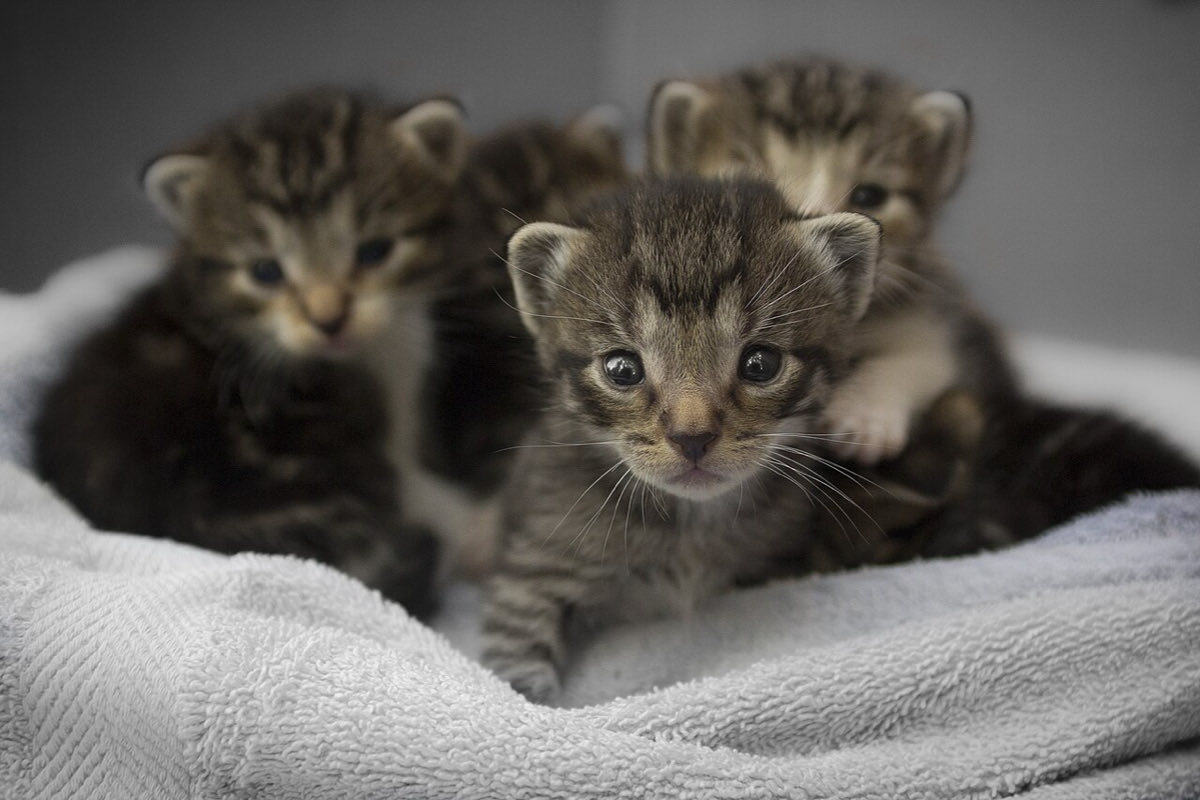
Finding a nest of tiny kittens can feel like an emergency, but the best first step is often to wait and watch. A mother cat may leave her kittens for hours at a time to find food, and she is better equipped to raise them than any human.
- Observe from a distance. If the kittens look clean, plump and are sleeping quietly in a pile, their mother is probably coming back. Watch from well away, out of sight, for a few hours. She won't return while people are close by.
- Act sooner if they're in danger. If the kittens are cold, wet, crying constantly, visibly sick or injured, in an unsafe spot such as a roadside, or the mother hasn't returned after several hours, they need help.
- Warm them first. Chilling is one of the biggest dangers for very young kittens. Warm a cold kitten gradually, against your body or on a heating pad set to low and covered with a towel, with enough room for the kitten to move off the heat. Never feed a cold kitten. A chilled kitten can't digest food properly, and feeding can make them very ill.
- Don't give cow's milk. It can cause severe diarrhea. Very young kittens need a commercial kitten milk replacer, fed in the right way and amount for their age.
- Get expert help quickly. Call a local veterinarian, animal shelter or kitten rescue group. Neonatal kittens need feeding every few hours around the clock, and kittens under about three to four weeks also need help to pee and poop. Many shelters run foster programs and can guide you or take the kittens.
Kitten emergencies: when not to wait
Kittens have tiny reserves of energy and fluid, and they can go downhill much faster than adult cats. Something that might be worth watching for a day in an adult cat can become serious within hours in a young kitten. When in doubt, call your veterinarian; that is exactly what they are there for.
Key takeaways
- Kitten-proof at floor level: string, cords, small objects, toxic plants, appliances and recliners.
- Feed a complete and balanced kitten food in several small meals a day, with fresh water and no cow's milk.
- See a vet within the first week; plan vaccines, testing, deworming, microchipping and spay or neuter timing together.
- Socialize gently and at your kitten's pace: handling, carrier, brushing, people and everyday sounds, always paired with good things.
- Never use hands as toys, and never punish. Redirect to toys and end play calmly.
- For found kittens, watch first, warm before feeding, and call a vet or rescue for help.
- Kittens decline quickly. Lethargy, not eating, vomiting, diarrhea or breathing trouble means call a vet now.