On this page
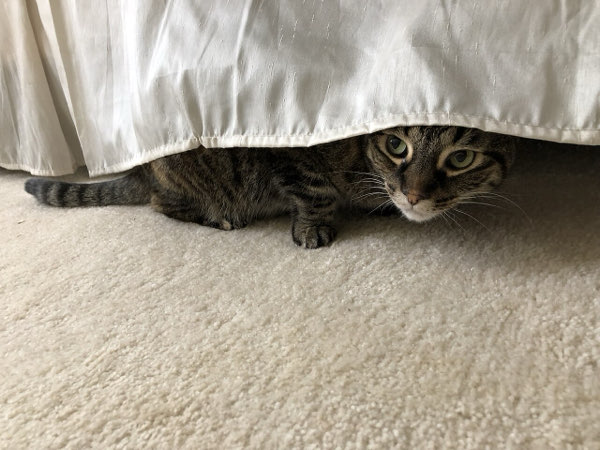
Cats are small predators who also happen to be prey for larger animals. Almost everything they do makes sense through that lens: the bursts of energy at dusk, the need to scratch and mark, the love of high perches, the preference for eating alone, and the way a sudden change can send them under the bed for a day. When we understand those instincts, we can give them healthy outlets, and many of the behaviors people find frustrating simply fade.
If your cat's behavior has changed suddenly, read the last section first: a surprising amount of "bad behavior" turns out to be pain or illness.
What every cat needs from their home
The American Association of Feline Practitioners (AAFP) and the International Society of Feline Medicine (ISFM) describe a cat's environmental needs in five broad areas, sometimes called the "five pillars." They are a useful checklist for any home, whether you have a single cat in an apartment or several cats in a house.
- A safe place. Every cat needs somewhere to retreat where they feel hidden and protected: a covered bed, a cardboard box on its side, a shelf in a closet, or a cat tree with an enclosed cubby. Ideally it is raised, has a view out, and can't be approached from behind.
- Multiple, separated key resources. Food, water, litter boxes, scratching areas, play areas and resting spots should be spread out rather than lined up in one corner. In multi-cat homes, each cat should be able to reach every resource without having to pass another cat. Cats generally prefer their water away from their food and their food well away from their litter box.
- Opportunities for play and predatory behavior. Hunting is hard-wired. Indoor cats need regular play that lets them stalk, chase and pounce, and ideally some way to "forage" for food.
- Positive, consistent and predictable human interaction. Most cats prefer frequent, short, gentle interactions on their own terms. Let your cat approach you, and pay attention when they signal that they've had enough.
- An environment that respects their sense of smell. Cats communicate through scent. They rub their cheeks on furniture and on you to leave familiar smells that help them feel secure. Strong cleaning products, air fresheners and scented litter can be unpleasant or stressful, and washing every bed and blanket at once removes reassuring scent marks.
Think vertically
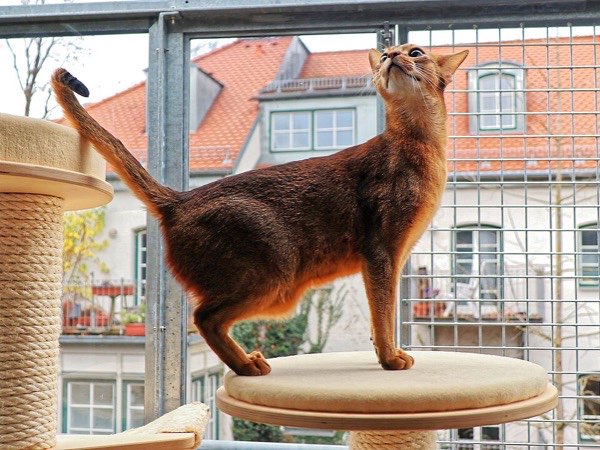
Cats experience their territory in three dimensions. Shelves, cat trees and window perches add usable space and give a cat somewhere to watch the world from a safe height. In multi-cat homes, vertical routes also let cats pass each other without a confrontation. If a window view includes neighborhood cats that upset your cat, a frosted film on the lower part of the glass can help.
Play that satisfies the hunter
A cat's hunting sequence has a clear shape: watch, stalk, chase, pounce, catch, kill, then eat. Good play follows the same arc. A session in which a toy dangles in the cat's face, or one that ends abruptly mid-chase, can leave a cat more wound up than when you started.
How to run a good play session
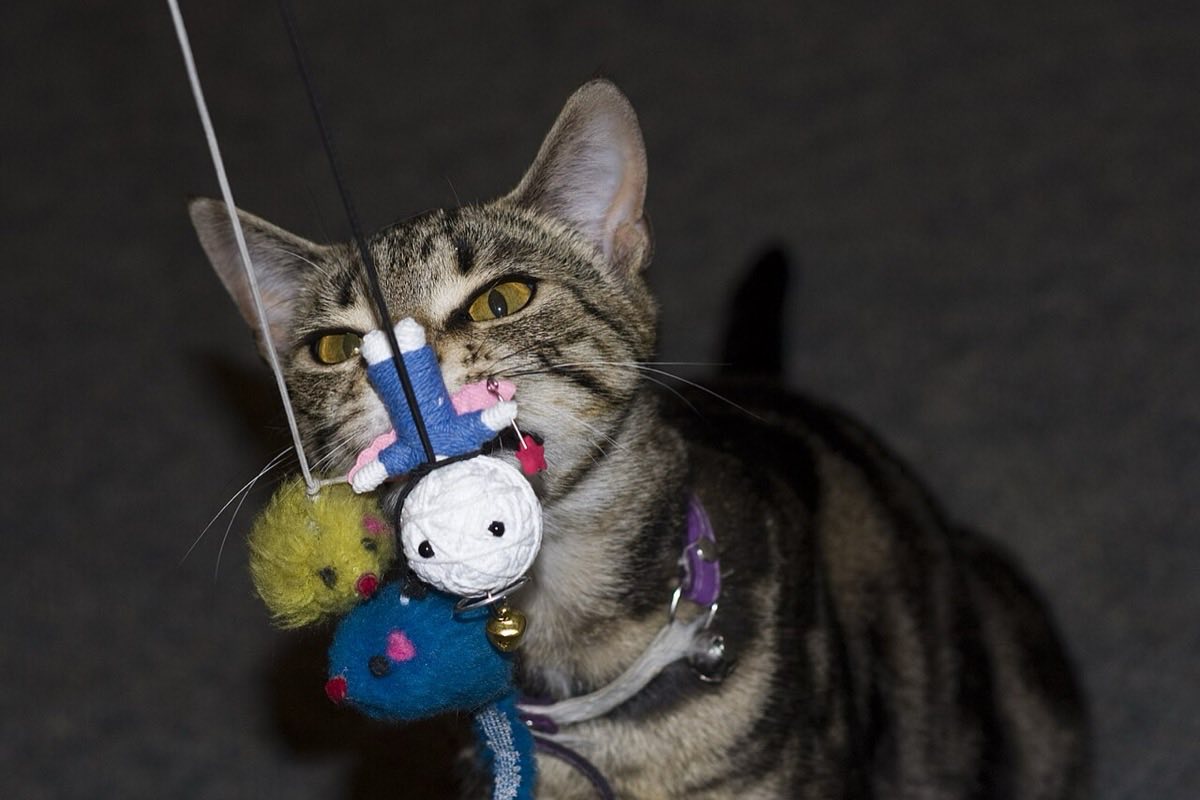
- Use a wand or "fishing pole" toy. It keeps your hands well away from teeth and claws and lets you move the toy like real prey.
- Move the toy like an animal, not like a toy. Prey moves away from a cat, not toward it. Let the lure skitter along the floor, disappear behind a chair, pause, twitch, then dart off again. Many cats prefer either "ground" prey (mouse-like movement) or "air" prey (bird-like fluttering), so try both.
- Let them catch it. Every few pounces, let your cat actually capture the toy and bite or bunny-kick it. Success is the point.
- Wind down, then finish with food. Slow the movement for the last minute or two, let them make a final catch, and then offer a meal or a small treat. Hunt, catch, eat, groom and sleep is the natural rhythm, and many cats settle beautifully afterward.
- Keep it short and frequent. Two or more sessions of around 10 to 15 minutes a day suit most cats better than one long one. Young and high-energy cats may want more. Dawn and dusk are natural hunting times, so an evening session can help a cat who races around at night.
- Rotate toys. Put wand toys away after each session (the string is a hazard if chewed) and rotate small toys every few days so they stay novel.
Why hands are not toys
Wiggling fingers under a blanket or wrestling with a kitten is tempting, but it teaches a cat that hands and feet are prey. What is cute at ten weeks is painful at ten months. Always put a toy between you and your cat's teeth. If your cat bites during play, stop the game calmly and walk away for a minute; don't yell, swat, or tap their nose.
Laser pointers
Many cats love chasing a laser dot, but it never lets them catch anything, which can be frustrating. If you use one, end each session by landing the dot on a physical toy or treat they can grab, and never shine it toward anyone's eyes. If your cat starts fixating on lights and reflections after laser play, switch to other toys.
Food puzzles and foraging
In the wild, a cat eats many small meals and works for each one. Food puzzles bring a little of that back. Start easy: a few pieces of kibble in a muffin tin, or treats under a few paper cups. Then try a treat ball that drops food when rolled, or a puzzle feeder designed for cats. You can also hide small portions of a daily ration around the house for your cat to "hunt." Increase difficulty slowly so your cat stays successful, and make sure they are still eating their full portion. Food puzzles are especially helpful for indoor cats, cats who eat too fast, and cats who need to lose weight. Our feeding guide covers portions in more detail.
Other enrichment ideas
Cardboard boxes, paper bags with the handles cut off, catnip or silvervine toys (not every cat responds to catnip), cat grass, clicker training, and a safe catio all add variety.
Scratching: a need, not a problem
Scratching is not a behavior you can or should stop. Cats scratch to remove the worn outer layer of their claws, to stretch the muscles of their back and shoulders, and to mark territory, both visually and with scent from glands in their paws. That is why cats often scratch prominent objects near doorways, beside sleeping spots, and in the busiest room of the house. The goal is to give your cat something better to scratch than your sofa.
What makes a good scratching post
- Tall enough that your cat can stretch out fully, with front legs extended overhead.
- Sturdy. A post that wobbles or tips over once will be avoided. A heavy base or a wall-mounted board makes a big difference.
- The right texture. Sisal rope or sisal fabric is popular. Some cats prefer corrugated cardboard, carpet or bare wood. Watch what your cat scratches now and match it.
- Both directions. Offer vertical posts and horizontal or angled scratchers. Many cats have a clear preference.
Where to put it
Placement matters more than price. Put scratchers where your cat already wants to scratch: near the furniture they've been using, next to where they sleep (cats like a good stretch and scratch on waking), and near entrances to rooms. A post hidden in a spare room rarely gets used. More than one scratcher, in more than one room, is ideal.
Redirecting scratching from furniture
- Place a scratcher directly in front of or beside the item being scratched.
- Temporarily make the furniture less appealing with double-sided tape, a fitted throw or a plastic corner guard.
- Rub catnip or silvervine on the new post, or dangle a wand toy over it so your cat's claws catch it during play.
- Praise or treat your cat when they use the scratcher.
- Trim nails regularly. Our grooming guide walks you through it.
Declawing
Declawing is not a nail trim. It is the surgical amputation of the last bone of each toe. It is opposed or strongly discouraged as an elective procedure by major veterinary organizations, including the AAFP, and it is banned in a number of countries as well as some US states and cities. Declawing can lead to lasting pain and to behavior problems such as litter box avoidance and biting. If scratching is causing a real problem in your home, the combination of good scratchers, nail trims and redirection works for most cats.
Soft nail caps are another humane option for some households. These small vinyl covers are glued over the claws and fall off naturally as the nail grows, so they need replacing every few weeks. Ask your veterinary team to show you how to apply them, or to apply the first set.
Reading your cat's body language
Cats are subtle communicators, and they tend to signal discomfort long before they hiss or swat. Learning their signals helps you know when to approach, when to back off, and when something is wrong. Always read the whole cat, not a single feature, and consider the context.
| Signal | What it often means |
|---|---|
| Tail held upright, perhaps with a little hook at the tip | A friendly greeting; a confident, social cat |
| Tail low, wrapped tightly or tucked | Worry or fear |
| Tail thrashing, lashing or thumping | Rising irritation or overstimulation; time to stop petting |
| Fur fluffed up along the back and tail | Fear or alarm, trying to look bigger |
| Ears forward | Relaxed or interested |
| Ears rotated sideways or flattened back | Anxious, irritated or frightened |
| Slow, soft blinks | Relaxed and comfortable; widely seen as a sign of trust |
| Wide, dilated pupils | High arousal, which can mean fear, excitement or play |
| Crouched, body tucked, weight back | Frightened and ready to flee or defend |
| Rolling over to show the belly | Trust and relaxation, but usually not an invitation for a belly rub |
| Rubbing cheeks on you or objects | Scent marking and social bonding |
The slow blink
A slow blink, where a cat looks at you and closes their eyes halfway or fully, then opens them again slowly, is generally a sign of relaxation and comfort. You can try it back: soften your gaze, blink slowly, and look slightly away. Many cats return the gesture. It is a lovely, low-pressure way to say hello to a shy cat.
Petting and overstimulation
A cat who enjoys a few strokes and then suddenly bites has usually given warnings: a twitching tail, rippling skin, ears turning sideways. Stop at the first sign. Most cats prefer strokes around the cheeks, chin and base of the ears.
Stress: signs, causes, and what helps
Cats are creatures of routine, and chronic stress can affect both behavior and health. Stress is linked with some urinary problems in cats, including a painful bladder condition called feline idiopathic cystitis, and with overgrooming and appetite changes.
Common signs of stress
- Hiding more than usual or for longer periods.
- Peeing or pooping outside the litter box, or spraying urine on walls and furniture.
- Overgrooming, sometimes leaving thin or bald patches on the belly or legs.
- Eating less, or occasionally more.
- Being unusually jumpy, watchful or irritable.
- Excessive vocalizing, especially at night.
- Less interest in play or in people.
Common causes
Household changes (a move, renovations, a new baby, visitors, someone leaving), a new pet or tension with another cat, unfamiliar cats seen through windows, too few resources or resources a cat must compete for, unpredictable handling or loud noise, boredom, and punishment.
What helps
- Keep routines predictable. Feed and play at roughly the same times each day.
- Add resources and spread them out. More hiding places, perches, litter boxes and feeding spots reduce competition.
- Let your cat choose. Don't drag a frightened cat out from under the bed. Make the hiding spot comfortable and let them come out when ready.
- Prepare for change. Before a move or a new arrival, set up a quiet room with familiar bedding, litter box, food and water, and introduce new things gradually.
- Consider a pheromone product. Plug-in diffusers and sprays that mimic the facial pheromones cats leave when they cheek-rub may help some cats feel more settled. They don't work for every cat and aren't a substitute for fixing the underlying cause, but they are low-risk to try.
Why punishment backfires
Yelling, spraying water, swatting or rubbing a cat's nose in an accident may stop a behavior in the moment, but it doesn't teach the cat what to do instead. It makes the cat associate you, or the place, with fear, and the extra stress tends to make litter box avoidance, spraying and aggression worse.
A better approach:
- Figure out the need behind the behavior. Is your cat scratching because there's no good post, jumping on counters because they want height or food, or waking you at 5 a.m. because that is when breakfast arrives?
- Provide an acceptable outlet for that need, in a place your cat wants to use.
- Make the unwanted option less rewarding without involving yourself as the source of unpleasantness: keep counters clear of food, use covers on furniture, or install a feeder on a timer.
- Reward the behavior you want with treats, play and attention.
- Be patient. Changing habits takes weeks, not days.
When cats in the same home don't get along
Cat conflict is often quieter than people expect. Open fighting with hissing, yowling and fur flying is obvious, but tension also shows up as one cat staring at another, sitting in a doorway or hallway to block access, chasing another away from the food bowl or litter box, or one cat spending most of the day hiding. The cat being bullied may start eliminating outside the box simply because getting to it feels unsafe.
Ways to reduce tension
- Multiply and separate resources. Offer several feeding stations, water bowls, litter boxes, scratchers and perches in different rooms, so no single cat can control them. For litter boxes, a common rule of thumb is one per cat plus one extra; see our litter box guide.
- Add escape routes and vertical space. Boxes with two exits, cat trees, and shelves help cats avoid each other.
- Play with each cat separately to burn off energy and build confidence, especially in a cat who is being picked on.
- Never let them "fight it out." Serious fights can cause injuries and abscesses and usually make the relationship worse. Interrupt by making a noise or putting a cushion between them, never your hands.
- Reintroduce if needed. If fighting is frequent, separate the cats and go back through a slow introduction, much as you would for a new cat. Our new cat guide explains the steps.
- Get help. Ongoing or serious aggression warrants a visit to your veterinarian, who may refer you to a veterinary behaviorist or a qualified behavior consultant.
Play aggression in kittens and young cats
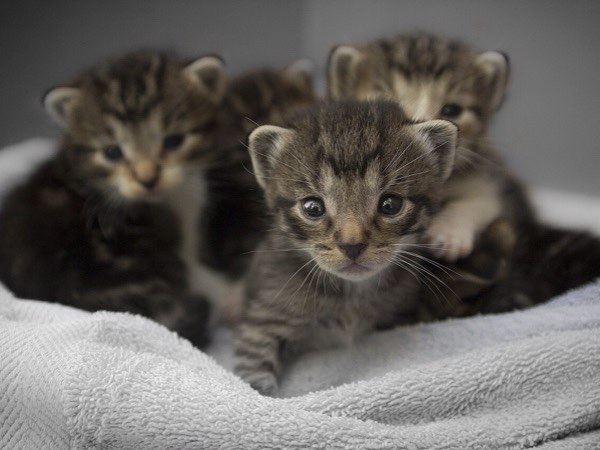
Kittens and adolescent cats are full of energy, and a lot of what looks like aggression is misdirected hunting play: ambushing ankles, attacking hands under the covers, or launching at legs as you walk past. It is normal, and it usually improves with age and the right outlets.
- Schedule several active play sessions a day with wand toys, and end each one with food.
- Keep a toy handy to toss ahead of your cat when you sense an ambush coming. A kicker toy or a crinkle ball gives them something legitimate to attack.
- If your cat grabs your hand or ankle, go still, then calmly disengage and walk away. Ending the fun is the most effective message.
- Never use physical punishment. It can make a kitten more defensive and more likely to bite.
- Consider whether your kitten needs a playmate. Kittens raised with other kittens tend to learn gentler play from each other. See our kitten care guide.
When a behavior change is really a medical problem
Cats are very good at hiding illness and pain, so changes in behavior are often the first clue that something is wrong. Before you assume a cat is being spiteful, stubborn or "just getting old," rule out a medical cause with your veterinarian. Some common connections:
- Peeing outside the litter box can be caused by urinary tract disease, bladder stones, kidney disease, diabetes or arthritis that makes climbing into the box painful.
- Sudden irritability or aggression may be a sign of pain, including dental pain or arthritis.
- Restlessness, night-time yowling and a big appetite in an older cat can point to hyperthyroidism, high blood pressure or cognitive changes.
- Overgrooming can be caused by fleas, allergies or pain, not only stress.
- Hiding and reduced play can signal illness of almost any kind.
Key takeaways
- Give every cat a safe place, separated resources, daily play, predictable gentle interaction, and respect for their sense of smell.
- Play like prey: stalk, chase, pounce, let them catch it, then feed them.
- Never use hands as toys, and put wand toys away after each session.
- Offer tall, sturdy scratchers in the places your cat already wants to scratch. Declawing is an amputation, not a fix.
- Watch the tail, ears and eyes, and stop petting at the first sign of irritation.
- Punishment increases fear and stress. Meet the underlying need instead.
- A sudden behavior change deserves a vet visit, and a cat straining to pee is an emergency.