On this page
Few topics generate as much argument among cat owners as food. Wet or dry? Grain-free? Raw? How much? The good news is that the fundamentals are fairly settled, and once you understand them, the marketing on the bag gets much easier to see through.
This guide covers what cats need, how to choose a food, how much and how often to feed, how to keep your cat hydrated, and which foods are dangerous. Every cat is an individual, and cats with medical conditions often need specific diets, so treat this as a starting point for a conversation with your veterinarian rather than a replacement for one.
Cats are obligate carnivores
Cats are what scientists call obligate carnivores. Over a long evolutionary history of eating prey, their bodies came to rely on nutrients that are found naturally in animal tissue. In practical terms, this means:
- Cats need more protein than dogs or people, and they use it for energy as well as for building and repairing tissue.
- Taurine is essential. Cats can't make enough of this amino acid on their own. A deficiency can cause a serious form of heart disease and blindness, which is one reason dog food is not safe as a cat's regular diet.
- They need certain nutrients in ready-made form, including vitamin A and the fatty acid arachidonic acid, which other animals can make from plant sources.
You don't need to calculate any of this yourself. Commercial cat foods that are complete and balanced are formulated to meet these needs. But it explains why cats should not be fed dog food, why vegetarian or vegan diets are not recommended for cats, and why homemade diets should only be fed if they have been formulated by a board-certified veterinary nutritionist. Homemade recipes from the internet and well-meaning books are very often missing essential nutrients.
Choosing a complete and balanced food
The most important words on a US cat food label are in a small, easily missed sentence called the nutritional adequacy statement. It is based on standards set by the Association of American Feed Control Officials (AAFCO) and tells you whether the food is a complete diet, and for which life stage. Look for wording along these lines:
- "Complete and balanced for growth" or for "all life stages": suitable for kittens (and, for all life stages, adults too).
- "Complete and balanced for adult maintenance": suitable for adult cats, not for growing kittens.
- "For intermittent or supplemental feeding only": this is a treat or a topper, not a meal. Many appealing "gourmet" foods fall into this category.
The statement will also say whether the food was formulated to meet AAFCO nutrient profiles or was tested in feeding trials. Both routes are acceptable.
Beyond that, the ingredient list is less useful than it looks. Words like "natural," "holistic" and "human-grade" are largely marketing, and the order of ingredients is influenced by water content. It is often more helpful to ask how the food is made. The World Small Animal Veterinary Association (WSAVA) publishes guidance on questions to ask a pet food company, such as whether it employs a qualified nutritionist, who formulates its diets, and what quality-control measures it uses. Your veterinarian can help you weigh these up.
Wet food vs dry food
Both wet and dry foods can be perfectly good diets as long as they are complete and balanced. Many veterinarians suggest including at least some wet food, and many households feed a mix. Here is how they compare:
| Wet (canned or pouch) | Dry (kibble) | |
|---|---|---|
| Water content | High, roughly three-quarters water | Low, around a tenth water |
| Hydration | Helps cats take in more water overall | Cats need to drink more from a bowl |
| Calories per mouthful | Lower, which can help with weight control | Higher, easy to overfeed |
| Convenience | Spoils if left out; opened food needs refrigerating | Easy to store, measure and use in puzzle feeders |
| Cost | Usually more expensive per day | Usually cheaper per day |
| Teeth | No specific benefit | Ordinary kibble does little for teeth; some dental diets are specially designed to help |
Wet food's main advantage is moisture. Cats evolved to get much of their water from prey and often don't drink much, so a diet that contains water can support urinary and kidney health. Wet food is often recommended for cats with a history of urinary problems, although your veterinarian may suggest a specific diet.
Dry food's advantages are practical. It is easy to measure, it can sit in a bowl or puzzle feeder without spoiling, and it costs less. The common belief that dry food keeps teeth clean is mostly a myth for ordinary kibble. Only certain diets designed for dental health have been shown to help, and those carry the Veterinary Oral Health Council (VOHC) seal.
If you feed wet food, don't leave it sitting in the bowl for more than a few hours, and less in warm weather. Cover and refrigerate opened cans and use them within the time stated on the label. Many cats prefer wet food at room temperature, so take it out of the fridge a little before mealtime.
Whatever you choose, introducing a cat to more than one texture while they are young can make life easier later. Adult cats can be very set in their preferences, which makes changing diets for medical reasons harder.
How much to feed
There is no single correct amount of food for a cat. Needs vary with age, size, activity, whether the cat is spayed or neutered, and the calorie content of the specific food. Overweight and obesity are among the most common nutrition problems vets see in pet cats, and extra weight is linked to diabetes, arthritis and other health problems, so portions matter.
A sensible approach:
- Start with the feeding guide on the label, based on your cat's ideal weight rather than their current weight if they are overweight.
- Measure every meal. Use a measuring cup or, better, a kitchen scale for dry food. "A scoop" can vary a lot.
- Count everything. If you feed both wet and dry, reduce each portion so the total stays right. Treats count too.
- Check body condition every few weeks and adjust in small steps.
To check body condition, look at your cat from above and from the side, and run your hands along their ribs. In a cat at a healthy weight:
- You can feel the ribs easily under a thin layer of fat, without pressing hard, but you can't see them.
- There is a visible waist behind the ribs when you look from above.
- The belly does not sag or swing much. Many cats have a loose flap of skin on the lower belly called the primordial pouch, which is normal and is not the same as fat.
Your veterinarian can score your cat's body condition at each visit and give you a daily calorie target, which is the most accurate way to set portions. Spayed and neutered cats often need fewer calories than intact cats, so keep an eye on weight after surgery.
How often to feed, and puzzle feeders
In the wild, cats eat many small meals throughout the day and night. Pet cats do well on a few measured meals rather than a bowl that is constantly refilled. Common approaches include:
- Kittens: three or four small meals a day, because their stomachs are small and they are growing fast.
- Adults: at least two meals a day. Many cats are happier with three or four smaller portions, which you can manage with a timed or automatic feeder.
- Free-feeding (leaving dry food out all the time) works for some cats who regulate their own intake, but it makes it hard to notice appetite changes and can lead to weight gain. If you do free-feed, measure out the day's total in the morning and don't top it up.
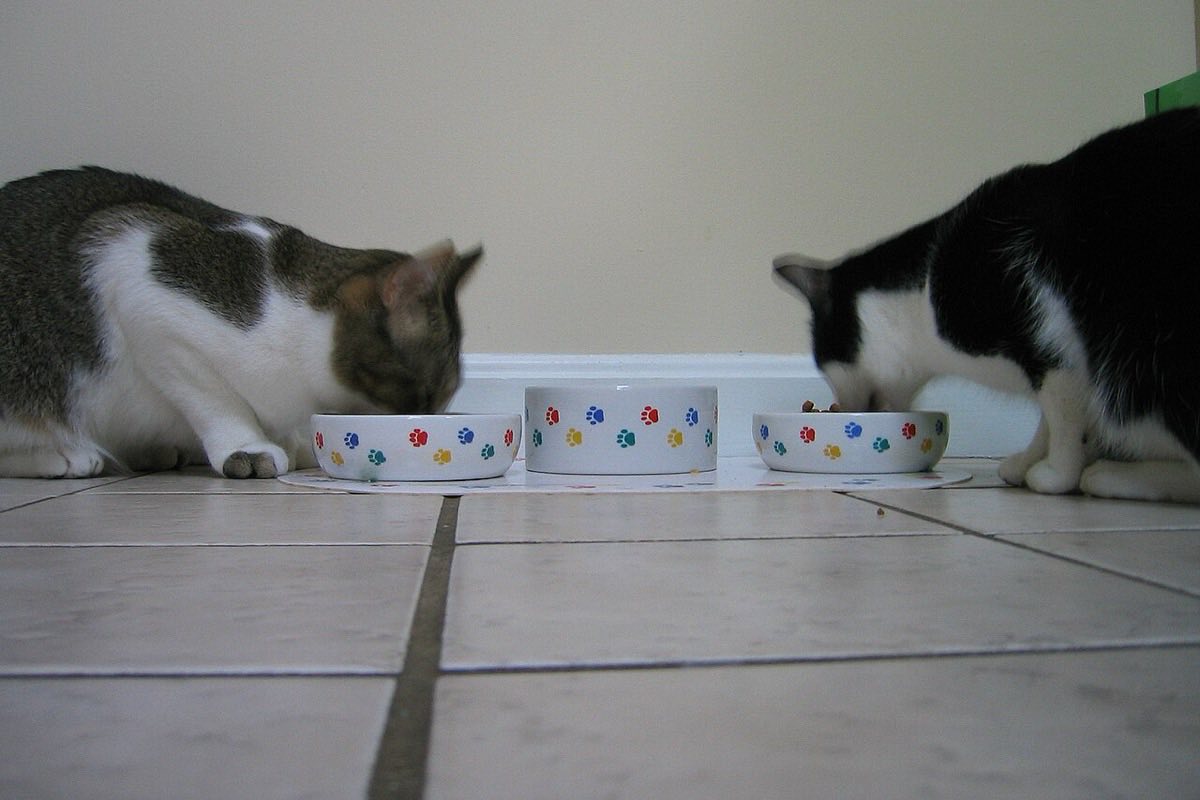
In multi-cat homes, feed cats separately or at least a good distance apart so no one is bullied away from their bowl or eats someone else's share. Microchip-activated feeders that open only for a specific cat are helpful when cats are on different diets.
Puzzle feeders and food enrichment
Cats are hunters, and in a home their food usually arrives in a bowl with no effort at all. Making them work a little for some of it is good for both body and mind. Food puzzles slow down fast eaters, give bored indoor cats something to do, and can help with weight control.
- Start with very easy puzzles, such as a few pieces of kibble in an egg carton or a muffin tin with some cups covered by balls, so your cat succeeds quickly.
- Try a treat ball that drops kibble as it rolls, or a flat puzzle with wells for wet food.
- Scatter part of a meal around a room for your cat to find, or hide small portions in different spots.
- Gradually make puzzles harder as your cat gets the idea.
Food puzzles should add to your cat's day, not create frustration. If your cat gives up and goes hungry, make the puzzle easier and keep a normal bowl meal in the routine. Our behavior and enrichment guide has more ideas.
Water and hydration
Many cats are not enthusiastic drinkers, so it is worth making water as appealing as possible:
- Fresh water every day, in a clean bowl. Wash bowls regularly, since a slimy film builds up quickly.
- Wide, shallow bowls. Many cats prefer them to deep, narrow ones. Ceramic, glass or stainless steel are easy to clean.
- Several water stations around the home, especially in multi-cat households and multi-story homes.
- Water away from food and litter. Many cats prefer to drink in a different spot from where they eat, and nobody wants to drink next to a toilet.
- Fountains. Some cats drink more from moving water. If you use a fountain, clean it thoroughly and replace filters as the manufacturer directs.
- Wet food adds a lot of water to the diet, and you can add a little water to wet food too.
Pay attention to how much your cat drinks. A noticeable increase in thirst, or much larger urine clumps in the litter box, can be an early sign of conditions such as kidney disease, diabetes or an overactive thyroid. Mention it to your veterinarian promptly rather than waiting for the next annual visit.
Treats
Treats are useful for training, bonding and making vet visits and grooming more pleasant. The usual guideline is to keep treats to no more than about 10 percent of your cat's daily calories, so the main diet stays balanced. A few practical points:
- Break treats into small pieces. Cats care about the reward, not the size.
- Use part of the daily kibble ration as treats for cats who need to lose weight.
- Small amounts of plain cooked chicken, turkey or fish with no seasoning, skin or bones are fine as occasional treats for most cats.
- Lickable treats are popular, but they count toward the day's calories too.
Changing your cat's food
Sudden diet changes can upset a cat's stomach and may lead some cats to refuse food altogether. Unless your veterinarian advises otherwise, switch gradually over about a week to ten days:
- Start by mixing a small amount of the new food into the old food, roughly a quarter new to three-quarters old.
- Every few days, increase the proportion of new food: half and half, then three-quarters new.
- Finish with the new food alone.
Some cats need a slower switch. If your cat stops eating, goes back to the old food and talk to your vet. Never try to "wait out" a cat who refuses a new diet. Cats don't simply eat when they get hungry enough the way many dogs will, and going without food is dangerous for them.
Foods that are dangerous to cats
Cats are generally less likely than dogs to raid the kitchen, but they still get into things, and their small size means a little can go a long way. Keep these well out of reach, and don't share them from your plate:
- Onions, garlic, chives, leeks and shallots, in any form, including powders, soups, gravies and baby food that contain them. They damage red blood cells and can cause anemia. Cats are especially sensitive.
- Chocolate and cocoa. They contain theobromine and caffeine, which can cause vomiting, a racing heart, tremors and seizures. Dark and baking chocolate are the most dangerous.
- Caffeine, including coffee, tea, energy drinks and caffeine pills.
- Alcohol, in drinks, desserts, mouthwash and hand sanitizer. Even small amounts can be dangerous for a cat.
- Raw yeast dough. It can expand in the stomach and produces alcohol as it ferments.
- Grapes and raisins. They can cause kidney failure in dogs. Whether cats are affected in the same way is less clear, so treat them as off-limits.
- Xylitol, a sweetener in some sugar-free gum, sweets, peanut butter and toothpaste. It is extremely dangerous to dogs. Its effects on cats are less well understood, so keep it away from them too.
- Cooked bones, which can splinter and injure the mouth, throat or intestines.
- Fat trimmings and very fatty foods, which can cause vomiting and diarrhea and may contribute to pancreatitis.
- Milk and cream. Despite the cartoons, many adult cats don't digest lactose well, and dairy can cause diarrhea.
- Raw fish fed regularly. Some raw fish contain an enzyme that breaks down thiamine (vitamin B1), and a long-term deficiency causes neurological problems. Tuna meant for people is also not a balanced diet, so keep it to an occasional treat.
- Dog food as a regular diet. A few stolen bites won't hurt, but dog food doesn't meet a cat's needs for taurine and other nutrients.
- Human medications and supplements, especially acetaminophen (Tylenol), which can be fatal to cats in very small amounts. See our guide to household dangers.
About raw diets: raw meat diets for cats are popular, but raw meat can carry bacteria such as Salmonella, Listeria and E. coli, which can make cats sick and can spread to the people in the household. In recent years, cats in the United States have also been infected with H5N1 avian influenza after eating raw pet food or drinking raw milk, sometimes fatally. Several major veterinary organizations, including the American Veterinary Medical Association, discourage feeding raw diets for these reasons. If you are considering one, talk it through with your veterinarian first.
Key takeaways
- Cats are obligate carnivores. Feed a commercial food labeled complete and balanced for your cat's life stage.
- Wet and dry foods can both be good choices. Wet food adds valuable moisture; many cats do well on a mix.
- Use the label as a starting point, measure meals, count treats, and adjust portions to body condition with your vet.
- Feed several small meals a day, and use puzzle feeders to add activity.
- Offer fresh water in several places, away from food and litter. Report any big increase in thirst to your vet.
- Change foods gradually over about a week to ten days.
- A cat who stops eating needs a vet's attention within a day or so, not a wait-and-see approach.
- Keep onions, garlic, chocolate, alcohol, caffeine, grapes, raw dough, cooked bones and human medications away from cats.