Scottish Fold at a glance
- Origin
- Scotland, 1960s
- Size
- Medium; rounded and sturdy
- Typical weight
- About 6–13 lb
- Coat
- Short and dense, or long (sometimes called Highland Fold)
- Colors
- Most colors and patterns
- Life expectancy
- Varies widely; joint disease strongly affects quality of life
- Grooming needs
- Low (shorthair) to moderate (longhair)
- Activity level
- Low to moderate, often limited by joint pain
On this page
Origin and history
Every Scottish Fold traces back to Susie, a white barn cat with unusual folded ears found on a farm in Perthshire, Scotland, in 1961. A neighbor, William Ross, acquired one of her kittens and began breeding the folded-ear trait, at first crossing with British Shorthairs and farm cats and later, in the United States, with British and American Shorthairs.
Concerns surfaced early. Breeders found that mating two folded-ear cats produced kittens with severe skeletal deformities, and fold cats were linked to joint and tail problems. In the United Kingdom, the main pedigree cat registry stopped registering the breed decades ago, and some major international registries do not recognize it either. Other registries, particularly in North America, continue to recognize it. In recent years, several countries and regions have restricted the breeding of cats with this mutation on animal welfare grounds.
Appearance
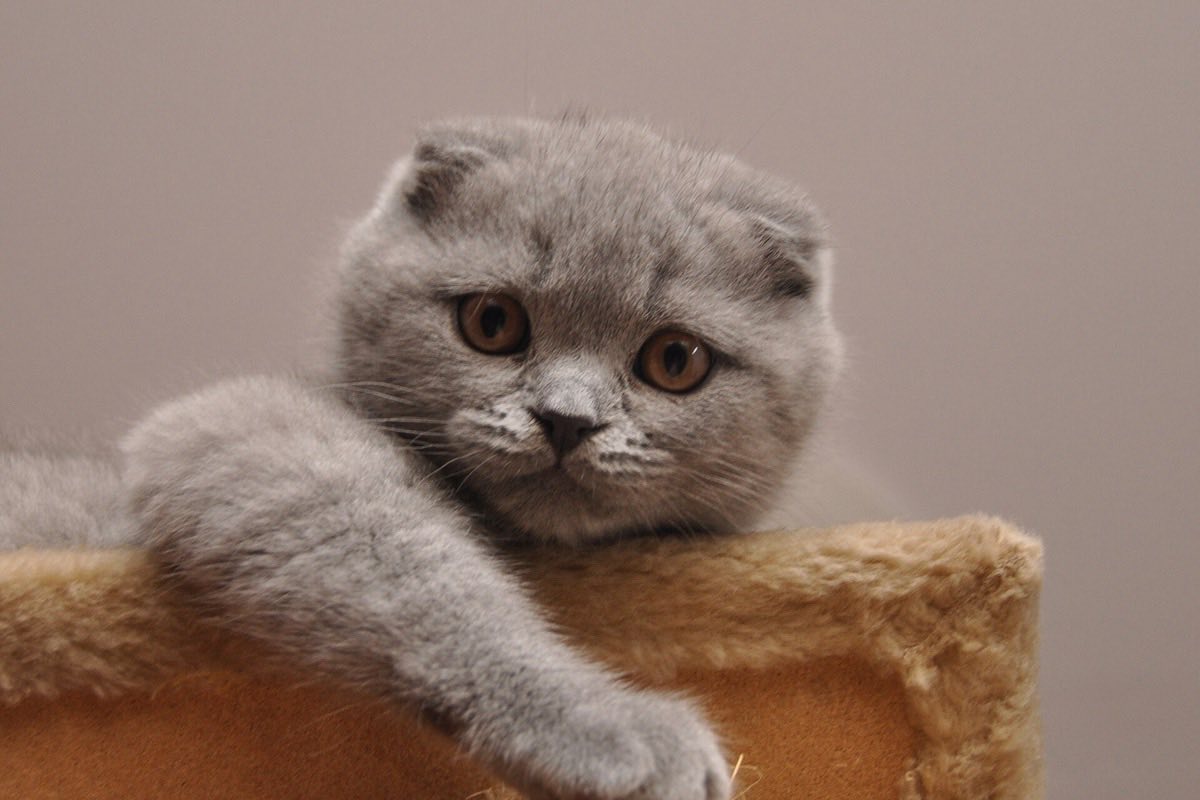
Scottish Folds are medium-sized, rounded cats with a round head, full cheeks, large round eyes and a short nose. In folded-ear cats, the ears bend forward and downward, ranging from a single loose fold to a tight triple fold that hugs the head like a cap. The coat can be short and dense or long, and almost any color or pattern is possible.
Kittens are born with straight ears. In kittens that carry the fold gene, the ears begin to fold at about three to four weeks of age. Kittens from the same litter that keep straight ears, often called Scottish Straights, generally do not carry the fold mutation.
Temperament
By temperament, Scottish Folds are usually lovely companions: calm, sweet-natured, adaptable and affectionate without being demanding. Many like being near their people and get along well with considerate children and other pets. They often have quiet voices.
Folds are famous for sitting in odd positions, such as upright on their haunches with their legs stretched out (sometimes called the "Buddha sit") or flat on their backs. These poses are often shared online as cute, but some veterinarians believe they may be ways of taking pressure off sore joints. A Fold that seems placid or reluctant to play may be uncomfortable rather than simply laid-back.
Care needs
Caring for a Scottish Fold is largely about comfort and pain management, now or in the future:
- Work with your veterinarian early. Ask for a baseline orthopedic exam, and discuss X-rays if there's any stiffness. Plan regular checkups to monitor joints.
- Manage pain properly. Cats hide pain well. Signs include reluctance to jump, stiffness, a short or stiff gait, avoiding stairs, reduced grooming, irritability when touched, and changes in litter box habits. Your veterinarian can offer pain relief options made for cats. Never give human painkillers; acetaminophen (Tylenol) is deadly to cats, and many other human pain medicines are dangerous for them.
- Adapt the home. Provide ramps or steps to favorite spots, low-sided litter boxes, soft, supportive bedding and food and water at floor level. See our senior cat guide for practical ideas that apply to any cat with arthritis.
- Keep your cat lean. Extra weight puts more strain on painful joints. Ask your veterinarian for a target weight.
- Handle gently. Never pull or bend the tail, and support the whole body when lifting.
- Ear care. Folded ears can trap wax; check them weekly and clean gently with a vet-recommended cleaner if needed.
Health considerations
The gene that causes folded ears is a dominant mutation affecting cartilage, the flexible tissue that shapes ears and lines and cushions joints. The result is a developmental disorder called osteochondrodysplasia. It is not something that only a few unlucky Folds get: all folded-ear cats have abnormal cartilage, although how severely it affects them varies from cat to cat.
- Common signs include a short, thick or inflexible tail, stiff or stilted walking, lameness, swollen joints (especially in the ankles and feet of the hind legs), reluctance to jump and painful, progressive arthritis. Bony growths can form around affected joints.
- Onset can be at any age. Some cats show signs as young kittens, others not until later in life, and problems typically worsen over time.
- Fold-to-fold matings produce kittens with two copies of the gene, which causes severe, crippling skeletal disease. Responsible registries prohibit such matings, but even a single copy causes disease.
Scottish Folds may also share other conditions seen in their outcross breeds, including hypertrophic cardiomyopathy (HCM) and polycystic kidney disease (PKD). Talk to your veterinarian about appropriate screening. Our health guide explains general warning signs.
Who the Scottish Fold suits
We don't recommend buying a Scottish Fold kitten, and we'd ask anyone tempted to think carefully about the welfare cost of the folded-ear look. If you're drawn to the breed's round face and calm personality, a British Shorthair or a straight-eared cat from a shelter can offer much the same temperament without the joint disease.
Scottish Folds already exist, of course, and many end up in shelters and rescues when owners can't afford their care. For a patient, attentive person who is prepared for ongoing veterinary costs and pain management, adopting one of these cats can be a deeply kind thing to do. A quiet home without many high places to jump to, and an owner who watches closely for signs of pain, gives a Fold the best chance of a comfortable life.